
 Kunststof Forte BV
 Polycarbonate vs Acrylic: Differences, Properties and How to Choose
What Exactly Are Polycarbonate and Plexiglass?
For many applications, you can choose from a range of plastic sheets. When comparing polycarbonate vs. plexiglass, the main differences lie in the base material and the intended application: whether you need a clear sheet for visibility or protection against impact.
Plexiglass: PMMA as a Clear Alternative to Glass
Plexiglass is a well-known name for PMMA (polymethyl methacrylate). In practice, it is used as a clear window replacement for displays, interior applications, protective screens, and signage, where a sleek appearance and good light transmission are important. Brand names you may also come across include Perspex and Deglas.
Polycarbonate: PC as an Impact-Resistant Protective Solution
Polycarbonate is PC (polycarbonate). This material is often chosen when safety and impact resistance are the primary requirements, for example for machine guards, vandal-resistant glazing, or canopies. In the market, you may come across brand names such as Makrolon and Lexan. Polycarbonate sheets are therefore a logical choice where there is a risk of impacts, hail, or other forms of physical damage.
Strength and Impact Resistance: A Major Difference in Use
Polycarbonate Hardly Ever Breaks on Impact
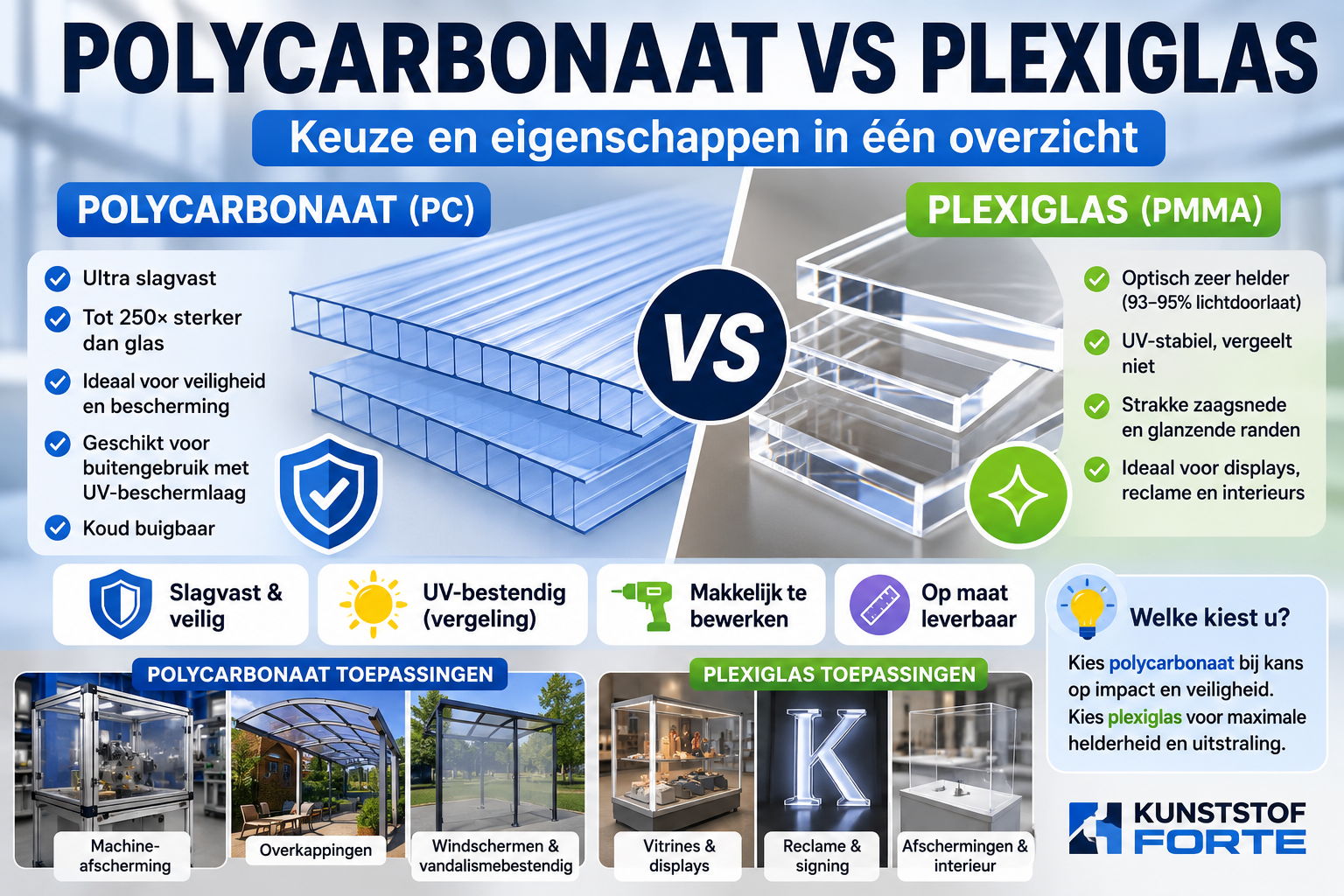
For applications where safety and impact resistance matter, polycarbonate is often the most practical choice. This material is up to 250× stronger than glass and approximately 30× stronger than plexiglass. Think of hail on a patio canopy, or a hard impact against a machine guard in a workshop. Where a stiffer sheet may crack or break, polycarbonate usually remains intact.
In practice, you will find that polycarbonate sheets withstand impacts better because the material:
- Absorbs impact energy instead of cracking immediately.
- Distributes the force over a larger surface area.
- Flexes under point loads, for example during a collision or when tools are dropped.
Plexiglass Is Stiffer but More Susceptible to Heavy Impacts
Plexiglass (acrylic) is relatively stiff and dimensionally stable. This is beneficial for applications where you want minimal deflection. However, under heavy impact, plexiglass is more likely to crack or break. If you expect impacts, vandalism, or flying debris, polycarbonate is generally the safer solution. Not sure which material to choose? We are happy to help you based on your application and the required sheet thickness.
Clarity, UV Resistance, and Ageing
Plexiglass Remains Clear Without an Additional Coating
If you want a screen, rooflight, or protective barrier that remains clear over the long term, the way the material responds to sunlight is especially important. Plexiglass (PMMA) is naturally UV-stable. It remains clear for many years and generally does not yellow, even without an additional protective coating. In addition, plexiglass allows a high level of light transmission: approximately 93–95%. This makes it suitable for applications where transparency and appearance are important.
Polycarbonate Requires a UV-Protective Coating
Polycarbonate is highly impact resistant, but without protection it is more susceptible to UV radiation. For this reason, polycarbonate sheets for outdoor use are usually provided with a co-extruded UV-protective layer on one side. This layer helps reduce yellowing and loss of strength caused by ageing. When installing the sheet, make sure it is oriented correctly: place the UV-protected side facing outwards. This side is often indicated by a protective film, printed markings, or a label.
You should also take light transmission into account: polycarbonate usually has a light transmission of around 8790%. Choose plexiglass if maximum clarity and UV stability are your main priorities, and polycarbonate if impact resistance and safety are more important.
Machinability: Sawing, Drilling, and Bending
Plexiglass Polishes Neatly and Cuts Cleanly
Do you want to make a neatly finished display, nameplate, or protective screen? Then plexiglass is often the easiest material to work with. The material is relatively hard and can be cut cleanly, giving you a neat saw cut with minimal fraying. You can also easily finish the edges afterwards: sanding and polishing create a clear, glossy edge. This is especially useful when the side remains visible, for example in a display case or counter display. When drilling, it is important to work slowly and support the material properly so that the edge around the hole remains neat.
Polycarbonate Can Be Cold Bent
With polycarbonate sheets, you will notice that the material is tougher. As a result, it may produce a slightly less “glass-clear” cut during processing, but it is more forgiving during installation and use. A major practical advantage: in many cases, polycarbonate can be cold bent, meaning without heating. This makes it suitable for applications with a slight curve, such as a curved canopy, windscreen, or protective cover. If you are going to saw or drill it, use sharp tools and prevent the material from becoming too hot for a clean result.
When Should You Choose Polycarbonate or Plexiglass?
Are you unsure between polycarbonate vs plexiglass? Then mainly look at the situation: is there a risk of impact, vandalism, or large temperature fluctuations, or are appearance and optical clarity more important? Below you will find common applications that help you make the right choice more quickly.
Applications Where Polycarbonate Is the Right Choice
Choose polycarbonate if you are looking for a sheet that can withstand impact. Think of machine guarding in a workshop or production environment, where safety and impact resistance are important. Polycarbonate is also often suitable for a windscreen at a bus shelter or sports facility, because it handles vandalism and heavy impacts better.
Choose polycarbonate as well if you are building a garden canopy and want a lightweight, strong solution. In many cases, a multiwall sheet is a practical choice because of its insulating air chambers and low weight, for example a 16 mm polycarbonate multiwall sheet.
Applications Where Plexiglass Is the Better Choice
Choose plexiglass if you are primarily looking for a clean, clear appearance. For a display case in a showroom or a display in a shop, optical quality is important: you want products to be clearly visible and the material to maintain its attractive appearance. Plexiglass is also often chosen for illuminated signage and sign-making because it transmits light beautifully and is easy to machine. Browse our range of custom-cut plexiglass sheets.
Order Both Materials Cut to Size at Kunststof Forte
Whether you choose polycarbonate vs plexiglass, at Kunststof Forte you can easily order both materials cut to size. You can directly select the right thickness and version in the range of polycarbonate sheets, or compare your choice with other plastic solutions. If you would first like to explore sizes, applications, and variants, view the complete product overview.
Are you still unsure which material is best suited to your application, for example for a protective screen, canopy, or machine guard? Then feel free to contact us. With practical, expert advice, we will help you choose the right sheet, taking into account safety, machinability, and service life. This way, you get the right solution without having to figure everything out yourself.