
 Kunststof Forte BV


Beschrijving
What is an HPL sheet?
An HPL sheet is a solid sheet of kraft paper that has been impregnated with thermosetting resin and compressed under high pressure and at high temperature. HPL stands for High Pressure Laminate. This production process results in a strong, homogeneous and dimensionally stable compact board. The board consists of a core paper, a base layer, decorative paper and a UV-cured top layer. As the core is solid, it is also referred to as a compact board or solid-core board. You can read more about the structure in our explanation of What is HPL?.
HPL panels and Trespa
Trespa is a brand name within the HPL product group and not a type of material. We supply HPL panels from UniKern®, which is also a brand within this product group. In both cases, these are HPL compact panels. You can find out how the brand and the material relate to each other on the page about the Trespa brand.
UniKern® HPL panels are available in over forty colours and designs, and in thicknesses ranging from 3 to 12 mm. The panels comply with EN 438-7 and bear the CE mark. We would be happy to discuss with you which variant is best suited to your project.
Our HPL range
Our range is based on three choices: thickness, texture and colour.
Thicknesses and sheet sizes
We supply HPL sheets in thicknesses of 3, 4, 6, 8, 10 and 12 mm, in the sheet sizes 2440 x 1220 mm and 3050 x 1300 mm. The correct thickness depends on the span: the greater the distance between the fixing points, the thicker the sheet.
| Thickness | Weight per m² | Tensile strength of a Torx screw |
|---|---|---|
| 3 mm | not specified | not specified |
| 4 mm | not specified | not specified |
| 6 mm | 8.4 kg | 2,000 N |
| 8 mm | 11.2 kg | 3,000 N |
| 10 mm | 14.0 kg | 4,000 N |
| 12 mm | 16.8 kg | 5,000 N |
The values are taken from the manufacturer’s technical data sheet. In practice, 6 mm is the most commonly chosen thickness for cladding, fascias and dormer windows. Please note: not every colour is available in every thickness and sheet size. You can see which combinations are available in the product selector at the top of this page.
Textures: smooth or grained
You can recognise the finish of an HPL sheet by the suffix following the colour name:
- Without any additives: a smooth, matt finish.
- NTX: a smooth sheet with an extra UV-resistant top coat.
- NTH: the wood-effect designs, with a tactile texture that follows the wood grain.
- NT: the metallic and stone-effect designs. These are special products with a different UV finish, so please bear in mind the direction of installation.
RAL colours
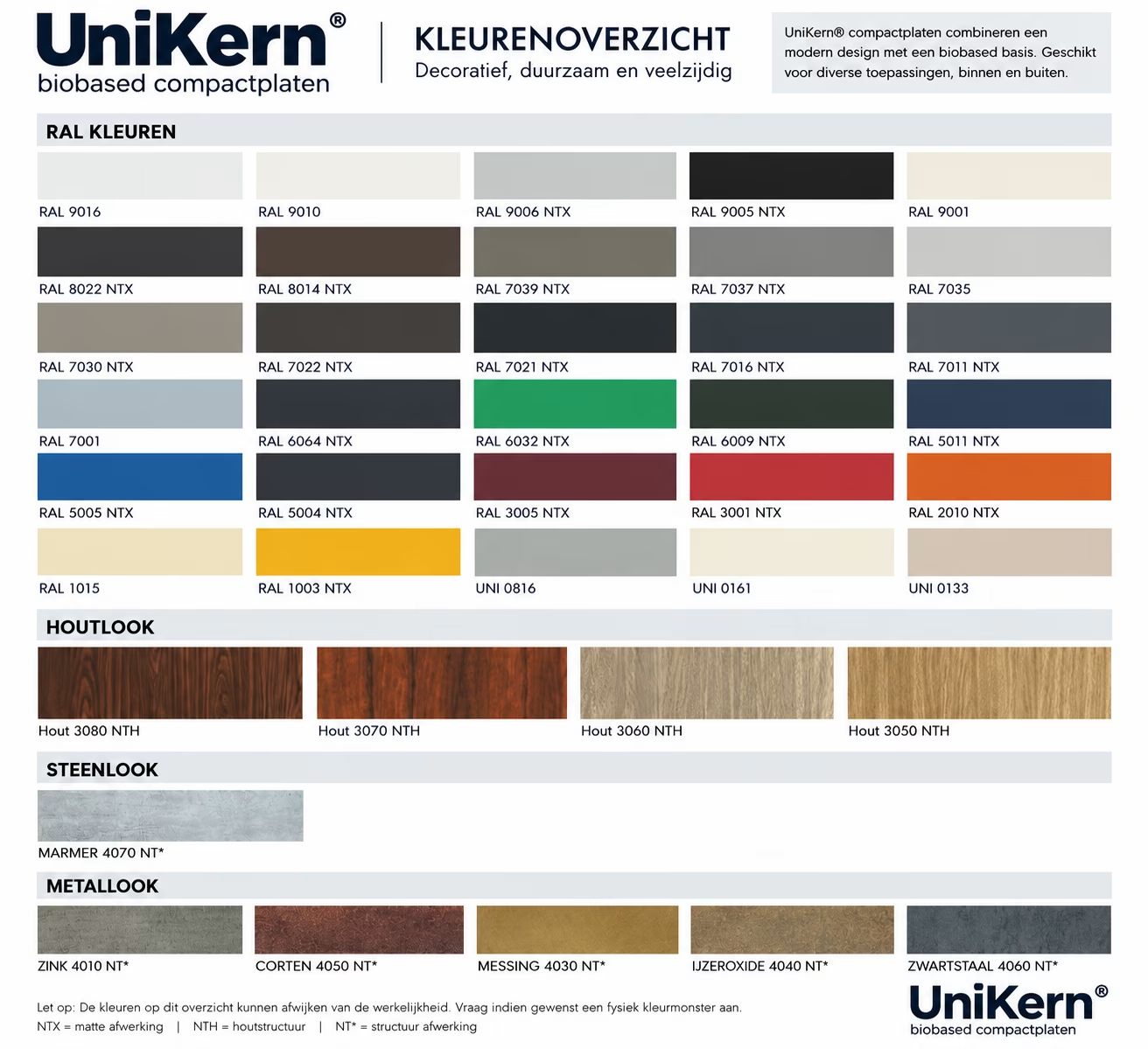
Our colour range comprises over forty options, the majority of which are RAL colours. We also supply UNI colours, four wood-effect finishes, five metallic-effect colours and a stone-effect finish. For façade cladding, anthracite RAL 7016, black RAL 9005 and white RAL 9010 are the most popular choices. As the panels are coloured on both sides, the edges also retain the same colour as the panel. If you are looking for a single solid colour, please take a look at the white HPL sheet. A RAL colour may appear different on a matt HPL sheet than it does in a colour chart or on a screen. You can find out why in our blog post on HPL colours.
Properties of HPL
HPL sheet material derives its strength from its solid core combined with the pressed top layer. The values below apply to our UniKern® HPL sheets.
| Feature | Value | Standard |
|---|---|---|
| Material | HPL compact board (High-Pressure Laminate) | |
| Structure | Cellulose sheets impregnated with thermosetting synthetic resins, pressed under high pressure and at high temperature to form a homogeneous sheet | |
| Surface | Double-sided, integrated, decorative, UV-resistant pigment coating | |
| Density | at least 1,350 kg/m³ | EN ISO 1183-1 |
| Bending strength | at least 100 MPa | EN ISO 178 |
| Modulus of elasticity | more than 10,000 MPa | EN ISO 178 |
| Increase in mass and thickness | less than 2% after 2 hours in water at 100 °C | EN 438-2 |
| Thermal conductivity | 0.23 W/(m·K) | DIN 52612 |
| Weather and UV resistance | 4 to 5 on the grey scale after 3,000 hours of xenon exposure, tested by TNO | EN ISO 20105-A02 |
| Fire classification | D-s2,d0 standard and B-s1,d0 in the fire-retardant version | EN 13501-1 |
| Factory production control | ISO 9001 | EN ISO 9001 |
| Product standard | EN 438-7 with CE marking |
The surface is coated on both sides with an integrated, decorative and UV-resistant pigment layer. To guarantee the colour for ten years, a large part of the collection also features an extra UV-resistant top coat. For a number of special editions with decorative designs, this finish differs. Please ask us which version is suitable for your application.
The panels are impact- and shock-resistant and require little maintenance. Annual cleaning with a non-abrasive, solvent-free cleaner is sufficient. Car shampoo creates a thin layer of wax that helps prevent the growth of algae.
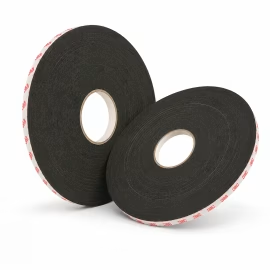
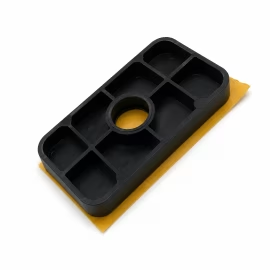
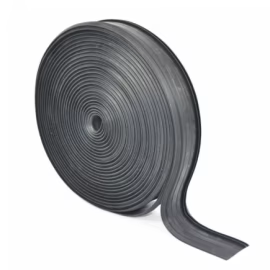
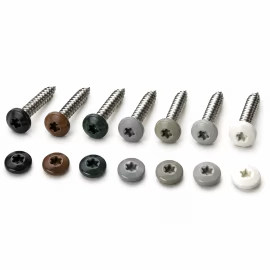
Like wood, HPL reacts to changes in temperature and relative humidity. Expansion is limited to a maximum of 2.5 mm per metre. Therefore, do not fit the panels flush against one another: leave an 8 mm gap and ensure there is a continuous ventilation space of at least 20 mm behind the panel. For fixing, we supply HPL accessories such as Torx screws, glue and sealing tape.
Bio-based and certified
Our HPL panels consist of at least 70% renewable raw materials, namely FSC® MIX CREDIT-certified kraft paper. The panels therefore meet the definition of bio-based building material as set out in the Dutch Government’s National Approach to Bio-based Construction. The panels comply with EN 438-7 and bear the CE mark.
Warranty on HPL panels
Our HPL sheets are covered by a ten-year warranty. The warranty covers colour fastness and protection against delamination during that period. It applies only if the product has been installed within the Benelux and has been fitted in accordance with the storage and installation instructions in force at the time of delivery. Minor, uniform colour changes caused by weather conditions are excluded from the warranty.
What is HPL used for?
HPL panels for outdoor use are mainly used on façades, as the material is weather- and UV-resistant, colourfast and low-maintenance. Indoors, HPL is the preferred choice due to its solid, scratch-resistant surface.
Cladding and fascia boards
Cladding is the most common application for HPL. The panels are installed as a ventilated façade on a timber supporting structure, with a continuous ventilation gap of at least 20 mm behind the panel. For fascia boards, roof edges and guttering edges, HPL is a low-maintenance alternative to timber: the colour is integrated into the panel. A thickness of 6 mm is usually chosen for these applications.
Dormer window and wind braces
HPL is suitable for dormer windows, wind braces, canopies and privacy screens thanks to its combination of low weight and high rigidity. A 6 mm sheet weighs 8.4 kg per square metre, making it easy to handle at height. The material is also dimensionally stable and impact-resistant.
Furniture-making and interior design
Indoors, HPL is used in furniture manufacturing, worktops, bathroom partitions and wall cladding. Its solid surface is scratch-resistant and easy to clean.
Need a made-to-measure HPL sheet?
If you require a non-standard size, we also supply made-to-measure HPL sheets. Simply enter the desired length and width in millimetres and you’ll see the price of the sheet straight away. For larger projects and business enquiries, please request a quote. Please visit our page for more information Custom-cut HPL sheet.
Frequently Asked Questions
Are HPL panels suitable for outdoor use?
Yes, HPL panels have been developed for outdoor use. Their weather and UV resistance has been tested by TNO in accordance with EN ISO 20105-A02 and scores 4 to 5 on the grey scale. However, for façades, the sheets must be installed in a ventilated manner.
What thickness of HPL sheet do I need?
For cladding, fascia boards, roof and gutter edges, and dormer windows, 6 mm is usually the preferred choice. For larger spans or more intensive use, 8, 10 or 12 mm are more suitable, whilst 3 or 4 mm is often sufficient for interior applications. If you’re unsure, we’d be happy to advise you.
What is the difference between HPL and Trespa?
The difference lies in the brand name, not in the type of material. Trespa is one of the best-known brands within the HPL product group. We supply HPL sheets from UniKern®, a brand within the same product group.
How much does an HPL sheet weigh?
A 6 mm HPL sheet weighs 8.4 kg per square metre. For an 8 mm sheet, this is 11.2 kg; for a 10 mm sheet, 14.0 kg; and for a 12 mm sheet, 16.8 kg. These figures are taken from the manufacturer’s technical data sheet.
What warranty do I get on HPL sheets?
Our HPL panels are covered by a ten-year guarantee against colour fading and delamination. The guarantee applies to use within the Benelux and provided the panels are installed in accordance with the applicable storage and installation instructions. Minor, uniform colour changes caused by weather conditions are excluded from this guarantee.
Can I order HPL sheets in a non-standard size?
Yes, as well as standard sheet sizes, we also supply custom-made sheets. Simply enter the required dimensions and you’ll see the price straight away.