

 Kunststof Forte BV
 Compact board, solid-core board or HPL board: one material, three names
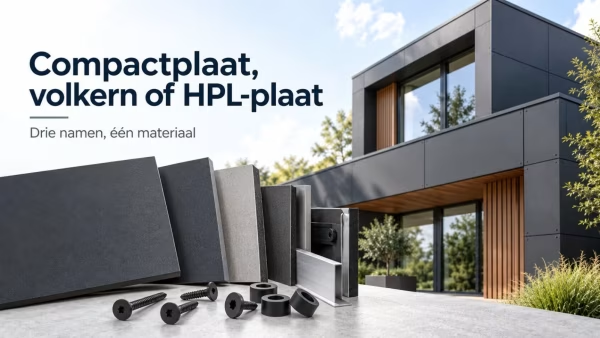
In practice, ‘compact board’, ‘solid-core’ and ‘HPL’ are three names for the same sheet material: a solid sheet made from compressed cellulose fibres and synthetic resin. The difference lies not in the material itself, but in who uses which term. Suppliers refer to it as compact board, the construction industry tends to use solid-core, and technical specifications mention HPL. What really matters when choosing your material, however, is the board’s specifications: interior or exterior grade, thickness and surface finish.
Below you can read where each term comes from, why Trespa is a brand name and not a type of material, and the three points to consider when choosing the right Customised HPL panels selects for your project.
What is a compact disc?
A compact board is a solid board made up of several layers of cellulose fibre, impregnated with synthetic resin and compressed under high pressure and temperature to form a single unit. The word compact refers to that continuous core: the plate is made entirely of the same material, with no hollow spaces and no separate backing.
In practice, this results in the following characteristics:
- Dimensionally stable: The sheet remains flat and does not require a supporting surface to retain its shape.
- Impact resistant: The surface is hard and resistant to knocks and scratches.
- Moisture resistant: The core absorbs very little moisture, which means the board does not swell.
- Editable: Sawing, milling and drilling can be carried out without exposing any delicate internal surfaces.
Volkern: same record, different term
“Volkern” is the Dutch term for exactly the same board and literally means ‘solid core’. The term originates from the construction and cladding sectors, where the material is primarily known as cladding. If you are looking for a ‘volledige kern’ panel, you are in fact looking for a compact panel. There is no technical difference in structure, strength or lifespan; only the terminology differs between sectors.
HPL is the technical term
HPL stands for High Pressure Laminate and is the international technical term for this material. You will find this abbreviation in specifications, product data sheets and standards, as it refers to the manufacturing process: layers of paper and wood fibre are compressed under high pressure to form a laminate. If you would like to find out more about its composition and properties in detail, please read on to learn more about the structure of HPL.
Trespa is a brand name, not a type of material
Trespa is a manufacturer of HPL panels and not a distinct type of material. As the brand has become so well-known in the Netherlands, the name is often used as a generic term — much like how people refer to “plaster”. As well as Trespa, manufacturers such as Arpa, Fundermax, Abet Laminati and Resopal also supply compact panels with similar properties. In our explanation of What sets Trespa apart Read on to find out when that brand is a logical choice.
Where the difference actually lies
The real differences lie not in the name, but in the design of the plate. These are the three factors that will determine your choice.
Interior quality or exterior quality
Exterior panels have an extra UV-resistant top coat and retain their colour in the sun and rain; interior panels do not have this coating. If you install an interior panel outdoors, the surface will visibly discolour within a few years. For façades, dormer windows, fascias and outdoor furniture, you should therefore always choose a Bespoke HPL exterior panels.
Thickness determines the application
The thickness is determined by the construction and the span between the fixing points. As a guide, please note:
- 3 to 4 mm: decorative and advertising applications, signage and lightweight cladding.
- 6 to 8 mm: cladding, dormer windows and fascia boards.
- 10 to 13 mm: table tops, worktops and bathroom partitions.
You can find an overview of standard dimensions in the Standard HPL dimensions.
Core colour and decor
The core of a compact board is black or dark brown as standard, but there are also versions with a white or solid-coloured core. This is a key consideration whenever cut edges remain visible, for example in worktops, bathroom partitions or cupboards without edge finishing. If your design calls for a seamless appearance, a solid-coloured board is the practical solution.
How to choose the right sheet
Start with the application, not the term. First, determine whether the sheet will be used indoors or outdoors, what the span of the structure is, and whether the cut edges will remain visible; the correct design will then follow naturally.
We supply all panels cut to size, so you won’t need to make any adjustments on site. For fixing, you’ll find the corresponding screws and spacers in the same range. If you are cutting the sheets yourself, our article on Precision cutting of HPL sheets you’re a bit on the strict side.
Frequently Asked Questions
Is a compact board the same as a solid-core board?
Yes. ‘Compact board’ and ‘solid-core board’ are two names for the same solid HPL board. There is no difference in their construction or properties.
Is HPL the same as Trespa?
Trespa is a manufacturer of HPL. All Trespa panels are HPL, but not all HPL panels are Trespa.
Can a compact panel be used outdoors?
Available in exterior-grade only. This version has a UV-resistant top layer and retains its colour; an interior-grade sheet will discolour when used outdoors.
How thick should a compact board for cladding be?
In most façade constructions, a thickness of 6 to 8 mm is used. The correct thickness depends on the distance between the fixing points.
Advice on choosing your materials
Are you unsure about the right solution for your project? Our specialists will work with you to decide on the choice of material, thickness and fixing method, so that you get the right material first time round. Request a quote with no obligation or get in touch for personalised advice.