

 Kunststof Forte BV
Comparing steel road plates with plastic, rubber and wood
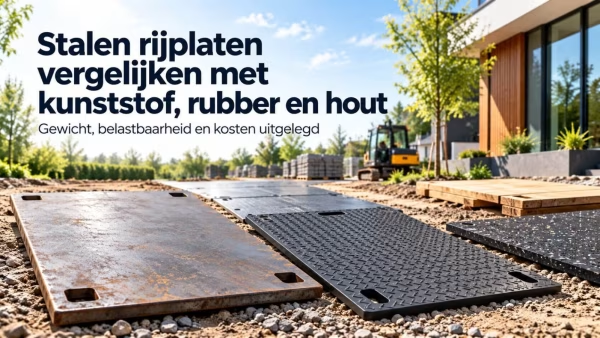
Steel road plates are heavy and are laid using a crane or excavator; plastic road plates are lightweight and can be laid without machinery. Steel is therefore the choice for heavy construction traffic and long-term construction access roads, whilst plastic is suitable for projects where you need to work quickly, without machinery and with a lower risk of damage to the subgrade.
In this article, we compare both materials in terms of weight, load-bearing capacity, installation method and cost. We also look at rubber, timber, concrete and composite materials. Kunststof Forte itself only supplies plastic road plates. That is precisely why we are honest about when steel is the better choice.
Steel or plastic road plates: the differences
The main difference between steel and plastic road plates is their weight: a steel plate of the same size weighs more than eight times as much. This difference determines how you lay, transport and store the plates. The table below compares the key characteristics.
| Feature | Steel road plates | Plastic road plates (PE) |
|---|---|---|
| Dimensions: 3000 x 1000 x 20 mm | approximately 471 kg | 57 kg |
| Laying | using a crane, excavator or backhoe loader | by two people using the handles; for larger models, a lifting aid may be required |
| Maximum load | suitable for very heavy traffic | 20 tonnes (2400 x 1200 x 15 mm) to 45 tonnes (3000 x 1000 x 20 mm), depending in part on the substrate and application |
| Damage to the subsoil | Steel edging can damage paving and lawns | Smooth, rounded edges reduce the risk of damage |
| Corrosion | rusts if left untreated | does not rust, does not absorb moisture |
| Vulnerability to theft | high, due to its scrap value | bearing |
| Maintenance | preserve or galvanise | rinse off with water |
The plastic values apply to the PE road plates from our range. They are made from 100% recycled LDPE (low-density polyethylene) and can be recycled again after use.
How much does a steel road plate weigh?
A steel road plate measuring 3000 x 1000 x 20 mm weighs approximately 471 kg; a plate measuring 3000 x 1500 x 20 mm weighs approximately 707 kg. These weights are based on the density of structural steel, which is 7,850 kg per cubic metre. A thickness of 20 mm is standard for steel road plates, but thinner and larger versions are also available.
| Dimensions (mm) | Steel (calculated) | PE plastic | Maximum load PE |
|---|---|---|---|
| 2400 x 1200 x 15 | approximately 339 kg | 40 kg | 20 tonnes |
| 3000 x 1000 x 20 | approximately 471 kg | 57 kg | 45 tonnes |
| 3000 x 1500 x 20 | approximately 707 kg | not available in 20 mm | n.a. |
Please note: this refers to the maximum load on the plate, not the maximum wheel load. The actual load a plate can bear depends in part on the subgrade and the application.
You cannot, therefore, lay a steel sheet by hand. You will need a machine for loading, unloading and laying, and a lorry with sufficient load-carrying capacity for transport. A 57 kg PE sheet can be moved by two people. For larger sizes, or when laying many sheets in succession, it is advisable to use a lifting aid.
Why is there greater interest in plastic road plates?
In the Netherlands, there are more than twice as many searches for plastic road plates as for steel road plates. According to Google Trends, the average search interest over the past five years stood at 58 for plastic road plates, compared with 22 for steel road plates. Google Trends shows relative interest on a scale of 0 to 100, not absolute search figures.

Search interest in plastic road plates (blue) and steel road plates (red) in the Netherlands over the past five years. Source: Google Trends, accessed in October 2026.
One key reason for this interest is that you can lay plastic road panels yourself, without the need for machinery. Our PE panels come with four handles as standard – two on each short side. With two people, you can lift a panel and lay it where required.
The 2000 x 800 x 15 mm version has a single handle on the long side. You can carry it like a suitcase, for example through a gate or along a narrow garden path to the back garden. That’s exactly where a tap won’t reach.
In addition, there are three practical considerations:
- Reduced risk of damage to the subsoil. Plastic has no sharp edges and reduces the risk of damage to, for example, lawns and decorative paving. However, it cannot completely prevent damage under all circumstances.
- Less transport. A complete set of panels will fit on a delivery van or trailer.
- Long-term employability. Plastic does not rust and does not absorb moisture. After use, simply hose down the sheets and stack them up.
Would you like to join the slabs to form a continuous carriageway? To do this, you will need drive plate couplings available.
When are steel road plates the better choice?
Steel road plates are the better choice for very heavy traffic, such as crawler cranes, fully laden lorries and concrete mixers, and for construction roads that are used daily for months on end. Steel deflects less under such loads and distributes the load over a larger surface area, even on soft ground.
Plastic has its limitations in this respect. The load-bearing capacity of a plastic driving plate depends on its thickness, the material it is made of, and the load-bearing capacity of the ground beneath it. Our 3000 x 1000 x 20 mm PE driving plate has a maximum load capacity of 45 tonnes, whilst the 2400 x 1200 x 15 mm plate has a maximum load capacity of 20 tonnes. These are maximum load capacities, not wheel loads: the actual load-bearing capacity also depends on the subgrade and the application. HMPE road plates They are more wear-resistant than PE and suitable for more intensive use. For heavy machinery such as crawler cranes, we recommend steel or a combination with a hardened surface.
Are you unsure whether plastic can withstand the stresses of your project? Please let us know the type of vehicle and the surface. We’ll give you honest advice, even if that means plastic isn’t the right solution.
Should I hire steel road plates or buy plastic ones?
Steel road plates are usually hired, as purchasing, transport and storage are too expensive for occasional use. When hiring, you often pay not only the hire charge but also for delivery, collection and the use of machinery to lay the plates. For a short-term project involving heavy traffic, hiring steel plates is therefore often the logical choice.
Buying plastic sheeting becomes a worthwhile option if you regularly need road plates. Think of a gardener who lays out gardens every month, or a builder with several small projects each year. The sheets will last for years, there’s no hire period to factor in, and you can lay them without machinery. A PE sheet costs between €38.00 and €130.00 each, depending on size and thickness. The price per sheet decreases when you buy 10 or more.
Whether buying is more cost-effective for your situation depends on how often you use the panels and how much you currently pay in hire and transport costs per project. We’d be happy to work this out with you.
Rubber road plates
Rubber road plates are flexible and conform well to the ground, making them suitable for light traffic and pedestrians on lawns. Rubber has a higher density than polyethylene and therefore weighs more for the same dimensions and thickness. For vehicles and machinery, a stiffer plate made of PE or HMPE is generally more suitable, as it distributes the weight over a larger surface area.
Wooden, concrete and composite road plates
Wooden, concrete and composite road plates are used less frequently than steel or plastic ones, each for its own reason.
Wood. Wooden partition panels are affordable to buy, but they absorb moisture and can rot and splinter with heavy use. As a result, they have a shorter lifespan.
Concrete. Concrete road plates are designed for semi-permanent construction roads and storage areas. Like steel, they are heavy and can only be laid using machinery.
Composite. Composite road panels combine plastic with reinforcing fibres or other materials. Their properties vary considerably from one manufacturer to another, so always check the load-bearing specifications before making your choice.
Which driving plate is right for your project?
Choosing the right traffic channelling plate depends on three factors: what type of traffic will be using it, how long will it be in place, and can you use a machine to lay it?
- Heavy machinery, for several months, machine on site: steel road plates, usually hired.
- Delivery van, mini-excavator or shovel, various locations: plastic road plates made of PE in 15 or 20 mm.
- Intensive use involving a great deal of wear and tear: HMPE.
- A narrow passageway or back garden: the 2000 x 800 mm PE sheet with a handle on the long side.
Are you unsure which panel is right for your project? Please get in touch for personal advice or request a offer We’ll work with you to find the right solution and deliver within 2 to 5 working days.