
 Kunststof Forte BV
 HPL sheet colours: what RAL colours and designs are available?
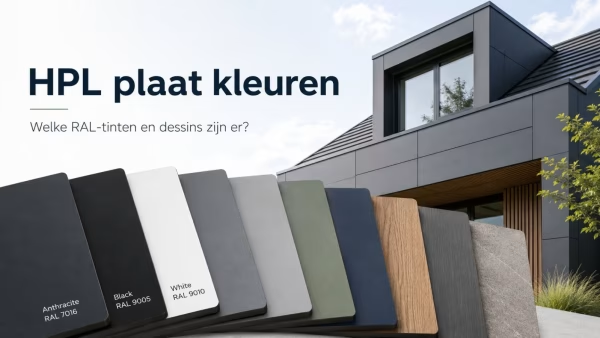
HPL panels are available in over forty colours and designs, the majority of which are RAL shades. The most popular HPL colours are anthracite RAL 7016, black RAL 9005 and white RAL 9010. We also supply wood-effect, metal-effect and stone-effect designs. Below you can find out which HPL sheet colours are available, the corresponding HPL RAL codes, how Trespa colours relate to these, and what to look out for when choosing a colour.
Which HPL colours are available in the RAL colour chart?
For bespoke HPL sheets, we supply 23 solid RAL colours in six thicknesses. The full range of colours and designs comprises over forty options. As the sheets are coloured on both sides, the cut edges also retain the colour of the sheet. The HPL sheet colours are grouped below by colour family; the shades shown below are a selection from the range.
Grey and anthracite
Shades of grey are the most popular part of the colour range. Colours available include anthracite RAL 7016, steel grey RAL 7011, silver grey RAL 7001, agate grey RAL 7038 and umber grey RAL 7022. Anthracite RAL 7016 is the most popular colour for cladding, fascia boards and dormer windows.
Black, white and warm shades
After anthracite, black (RAL 9005) and white (RAL 9010) are the most popular shades. If you’re looking for a single standard colour from stock, take a look at the white HPL sheet. Our range of warm colours includes ivory (RAL 1015), zinc yellow (RAL 1018), pastel orange (RAL 2003), signal red (RAL 3001), wine red (RAL 3005) and a sand colour.
Shades of green and blue
For projects with a rustic or heritage-style appearance, pine green RAL 6009 and heritage green RAL 6064 are available. In blue, we supply steel blue RAL 5011, traffic blue RAL 5017 and black blue RAL 5004. These shades are more commonly used on storage sheds, canopies and privacy screens than on entire façades.
Search for a specific HPL RAL code
If the RAL code you are looking for is not listed in the configurator, please enquire about the options available. The range of HPL RAL colours is a selection from the RAL Classic colour chart, so not every code is available as an HPL sheet. In practice, this often comes down to one of the following three situations:
- Anthracite RAL 7016. The standard choice for cladding, fascia boards and dormer windows; available from stock and also available to order made to measure.
- Black-grey RAL 7021. This shade is often confused with anthracite RAL 7016. RAL 7021 is darker and tends towards black, whilst RAL 7016 is greyer and bluer. If you are looking for RAL 7021, please submit your enquiry to us; we will advise you which HPL shade comes closest to it.
- Black RAL 9005. After anthracite, this is the most popular shade, particularly for fascia boards and roof edges.
We advise against ever assessing a RAL code on a screen. The appearance varies from screen to screen, and the matt, slightly textured top layer of HPL looks different from a spray-painted or powder-coated surface in the same colour code. If in doubt, please request a sample.
Why a RAL colour may look different on HPL
The same RAL code may appear different on HPL than it does on a RAL colour chart, on paint or on powder-coated metalwork. This is not a colour deviation, but a difference in colour perception. A RAL code defines the colour, not the surface on which that colour is displayed. HPL has a matt, slightly textured top layer with a low gloss level, whilst a colour chart or satin-gloss cladding reflects light differently. As a result, the same shade on HPL generally appears slightly deeper and less saturated.
Four factors determine how a colour is perceived:
- A smooth panel, a wood-effect finish and a sprayed surface reflect light in slightly different ways.
- HPL has a matt finish. Compared to a satin or high-gloss finish in the same RAL code, the sheet appears darker.
- Lighting and surroundings. Northern lights, direct sunlight and artificial light each create a different impression, as does the colour of the surrounding brickwork or timber.
- Colours on a monitor, tablet or mobile phone almost always differ from the actual product.
Please note: colour rendering of HPL panels
The RAL colours listed are provided for reference only. The visual perception of colour may differ from that of a RAL colour chart, paint or any other material with the same RAL colour. This may be due, amongst other things, to the surface texture, gloss level, lighting conditions and surroundings. The colour displayed on a screen may also differ from the actual product.
Is precise colour matching important for your application? If so, please request a colour sample before placing your order and, ideally, assess it under the lighting conditions in which the material will ultimately be used.
If the sheet needs to be fitted alongside existing window frames, roof edges or flashings, always request a sample first. Place the sample next to the existing work, in the exact position and at the exact height where the sheet will be installed, and assess it both in daylight and in the shade. This will take a few extra days, but it will prevent any disputes later on about a sheet that has already been cut to size.
Finishes: wood-effect, metal-effect and stone-effect
Not all HPL colours are plain: in addition to the solid RAL shades, we supply four wood-effect designs, five metallic-effect colours and one stone-effect finish. These include rustic oak, weathered oak, whitewash, Corten steel-effect, concrete-effect, limestone and zinc. You can identify the finish by the suffix following the colour name:
- Without any additives: a smooth, matt finish.
- NTX: a smooth sheet with an extra UV-resistant top coat.
- NTH: the wood-effect designs, with a tactile texture that follows the wood grain.
- NT: the metallic and stone-effect designs. These are special products with a different UV finish; please therefore take the installation direction into account.
Colour options for bespoke orders and standard sheet sizes
We supply the designs exclusively in standard sheet sizes; for bespoke orders, the 23 solid RAL colours apply. If you choose a wood-effect, metal-effect or stone-effect sheet, you will therefore order it in the sheet sizes 2440 x 1220 mm or 3050 x 1300 mm. Please see our HPL sheets in standard sizes. If you would like a coloured HPL sheet in a non-standard size, please first select the RAL colour and the thickness, and then specify the length and width in millimetres at Custom-cut HPL sheet and you’ll see the price straight away.
Please note: not all HPL sheet colours are available in every thickness and sheet size. When selecting a product, you will see which combinations are available. If you are unsure about a combination of colour, thickness and dimensions, please contact us. We would be happy to work with you to find a practical solution for your project.
Which colour would you choose for your cladding?
In practice, anthracite RAL 7016 is the most commonly chosen colour for cladding, followed by black RAL 9005 and white RAL 9010. These shades complement the most commonly used window frame and roof edge colours and combine well with timber, brick and stucco. For façade panels, a thickness of 6 mm is usually chosen, in a ventilated installation with a minimum of 20 mm of space behind the panel.
Combining colour and thickness
Not every colour is available in every thickness, but we supply the most popular shades across the full range of thicknesses from 3 to 12 mm. A 10 mm black HPL sheet weighs 14.0 kg per square metre and has a tensile strength of 4,000 N per Torx screw; this makes this combination suitable for larger spans, balcony infills and panels subject to heavier loads. For cladding in the same colour, 6 mm is usually sufficient. You can see which combinations of colour, thickness and sheet size are in stock in the product selection.
The colour does not affect installation. The specified expansion of up to 2.5 mm per metre applies to all shades, so regardless of the colour, maintain a joint width of 8 mm and use a drill hole of at least 8 mm. The corresponding HPL accessories Please order them at the same time. If you are cutting the sheets yourself, please read our tips for precision cutting of HPL.
Do the colours of an HPL sheet stay looking good?
Yes, HPL panels are colourfast. Their weather and UV resistance has been tested by TNO in accordance with EN ISO 20105-A02 and scores 4 to 5 on the grey scale after 3,000 hours of xenon exposure. The decorative pigment layer is integrated into both sides of the sheet, meaning the colour does not need to be touched up with paint.
To ensure the colour remains intact for ten years, a large proportion of the collection features an extra UV-resistant top coat. Our HPL panels come with a ten-year guarantee against colour fading and delamination, provided they are used within the Benelux and installed in accordance with the applicable storage and installation instructions. Minor, uniform colour changes caused by weather conditions are excluded from the guarantee.
Maintenance is minimal: annual cleaning with a non-abrasive, solvent-free cleaner is sufficient. You can read more about this at Cleaning HPL panels.
Trespa colours and RAL: how do they compare?
Trespa uses its own colour collection rather than RAL codes, even though the material belongs to the same product group. This is because Trespa is a brand name within the HPL product group and not a type of material. If you are looking for Trespa colours in RAL, you are in fact looking for an HPL sheet in a RAL shade.
This explains why a Trespa colour name cannot be converted directly into a RAL code: they are two different colour systems. We supply HPL panels from UniKern®, another brand within this product group, where the shades are designated by a RAL code. For most projects, this is more practical, as window frames, roof edges and lettering are also ordered in RAL, ensuring that the colours match.
If you have an existing Trespa façade that you wish to extend or repair, please provide the colour name and, if possible, a photo number or the reference number of a remaining panel. We will then identify the RAL shade that most closely matches it. You can find out how the brand and material relate to one another on the page about the Trespa brand. You can find out more about the structure of the material in our guide to What is HPL?.
Frequently Asked Questions
How many HPL colours are available?
Our range of HPL colours comprises over forty shades and designs. Of these, 23 solid RAL colours are also available to order in custom sizes. The remaining options are wood-effect, metal-effect and stone-effect designs in standard sheet sizes.
Which HPL colour is the most popular?
Anthracite RAL 7016 is the most popular colour, particularly for cladding, fascia boards and dormer windows. This is followed by black RAL 9005 and white RAL 9010.
Can I order a custom-sized HPL sheet in a specific RAL colour?
Yes, provided the colour is one of the 23 solid RAL colours that we supply for bespoke orders. You choose the colour and thickness, specify the length and width in millimetres, and the price is displayed immediately.
Are the edges of an HPL sheet coloured as well?
The panels are double-sided in colour, ensuring that the visible sides retain the chosen shade. The solid core is dark; with light colours, the cut edge is therefore visible. Edge varnish and cover strips are available to achieve a coloured finish.
Do HPL panels fade in the sun?
The sheets are colourfast and score 4 to 5 on the grey scale after 3,000 hours of xenon exposure. A ten-year guarantee applies to colourfastness. Minor, uniform colour changes caused by weather conditions are excluded from the guarantee.
The colour of my HPL sheet is different from the RAL colour chart. Is this the correct delivery?
Probably. The RAL code specifies the colour, not the finish. As HPL has a matt, slightly textured top layer, the same code will look different from how it appears on a colour chart, on paint or on semi-gloss printed material. Lighting conditions and the surroundings also play a part. If exact colour matching is important, please request a colour sample before placing your order.
Is HPL available in RAL 7021?
RAL 7021 black-grey is not a standard option in the configurator and is often confused with anthracite (RAL 7016). RAL 7021 is darker and tends towards black. If you submit your enquiry to us, we will advise you which available shade is the closest match.
What is the difference between Trespa colours and RAL colours?
Trespa uses its own colour collection without RAL codes. The HPL panels we supply are, however, designated in RAL shades, ensuring they match window frames, roof edges and lettering that are also ordered in RAL colours.
Is a black HPL sheet in 10 mm thickness available?
Black RAL 9005 is one of the most popular colours and is commonly used across the full range of thicknesses from 3 to 12 mm. A 10 mm sheet weighs 14.0 kg per square metre and has a tensile strength of 4,000 N per Torx screw.
Is every colour available in every thickness?
No. Not every colour is available in every thickness and sheet size. When selecting a product, you will see which combinations are available; we keep the most popular colours in stock.
Advice on choosing your colour
Are you finding it difficult to decide which colour would best suit your façade, dormer window or canopy, given the wide range of HPL sheet colours available? We’d be happy to help you choose and offer advice based on the intended use, the required thickness and the available sheet sizes. For larger projects and business enquiries, we’ll provide you with a quote. Please contact us for expert advice.